
Our brains are energy-hungry machines that hate “not knowing.” In fact, a famous study published in Nature Communications showed that people are actually calmer when they know for sure they’re getting an electric shock than when they have a 50% chance of one. The ambiguity, not the pain, is what causes the stress.
In sport, we call this “playing tight.” When the game gets chaotic, your brain defaults to a “doom mindset” to protect you. But elite performance requires the opposite: Negative Capability. This is the ability to sit in uncertainty and doubt without reaching for a “panic button” or a simple excuse.
The “Instruction Manual” for Navigating the Unknown
Here is your 4-step plan to stop fearing the chaos and start using it as a competitive advantage:
Step 1: Pivot to Curiosity (The “Duck-Rabbit” Hack)
When things go sideways – like a bad call or a sudden injury – your brain will rush to a “conclusion” (usually a negative one).
- The Action: Use the “Duck-Rabbit” technique. Just as you can train your brain to see both animals in the famous optical illusion, train yourself to find two different meanings for every “disaster.”
- Instead of “This bad call ruined the game,” ask: “What do I not know yet about how this call might change our strategy?” Curiosity kills the “doom” response.
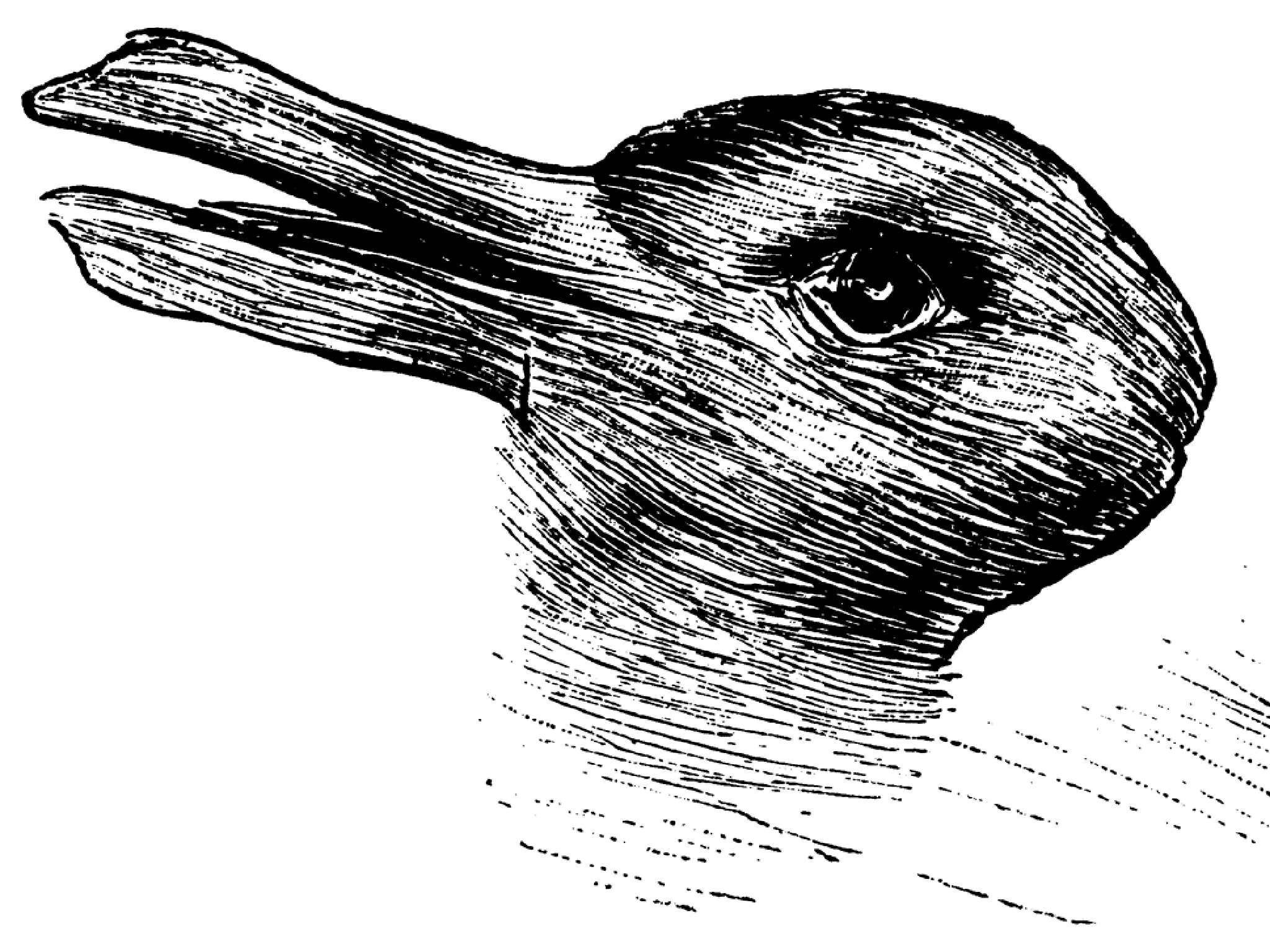
[“Kaninchen und Ente” (“Rabbit and Duck”) from the 23 October 1892 issue of Fliegende Blätter]
Step 2: Stabilize the “Energy Leak”
Because uncertainty is “computationally expensive,” it drains your mental battery faster than physical effort. If you’re anxious about the outcome, you’re gassing out before the third period.
- The Action: Use Tactical Breathing/Box Breathing (slow, deep breaths) to settle your nervous system.
- By stabilizing your physiology, you “buy” your brain the energy it needs to recalibrate instead of panicking.
Controlling Stress in Real Time
Step 3: Apply the “Formula One” Rule
Mark Gallagher of F1 racing notes that they go into every race knowing most things are out of their control. They don’t focus on prediction; they focus on adaptability.
- The Action: Stop trying to control the outcome. Instead, create a “If/Then” Script. “If the wind picks up, then I will adjust my footwork.”
- This gives your brain the “pattern” it craves without the rigid need for a perfect environment.
Step 4: Audit Your “Emotional Circle”
Emotions are contagious. If you’re surrounded by people who catastrophize every loss, your brain will adopt that “doom” filter as its default setting.
- The Action: Surround yourself with “Reflective Performers” – coaches and teammates who treat uncertainty as a puzzle to be solved rather than a threat to be feared.
The Bottom Line: Uncertainty isn’t a threat; it’s the place where opportunity lives. If the game were perfectly predictable, there would be no point in playing. Train your brain to tolerate the “not knowing,” and you’ll find yourself moving while everyone else is frozen with uncertainty.
Sources:
- Critchlow, H. (2026). The 21st century brain: Cutting edge neuroscience to help us navigate the future. Transworld Publishers Ltd.
- Critchlow, H. (2026). How to Train Your Brain to See Possibility Instead of Doom. The Guardian.
- de Berker, A. O., Rutledge, R. B., Mathys, C., Marshall, L., Cross, G. F., Dolan, R. J., & Bestmann, S. (2016). Computations of uncertainty mediate acute stress responses in humans. Nature Communications, 7(1), 10996.